

Ground Pokémon can give a team exceptional offensive coverage and a valuable Electric immunity. Ground-type attacks hit five types for super-effective damage. Understanding their weaknesses and special matchup rules helps you use them far more effectively.
| Key fact | What to know |
|---|---|
| Weak against | Water, Grass, Ice |
| Resists | Poison, Rock |
| Immune to | Electric |
| Strong against | Fire, Electric, Poison, Rock, Steel |
| Ground attacks struggle against | Grass, Bug |
| Ground attacks cannot normally hit | Flying-type Pokémon |
| Famous move | Earthquake |
| Useful team roles | Physical attacker, defensive pivot, Electric switch-in |
Quick answer: Ground-type Pokémon are weak to Water, Grass, and Ice attacks. They resist Poison and Rock while ignoring Electric attacks, and their Ground moves hit Fire, Electric, Poison, Rock, and Steel for super-effective damage. Flying opponents normally avoid Ground moves entirely.
Ground Pokemon Weaknesses: What Beats Them?
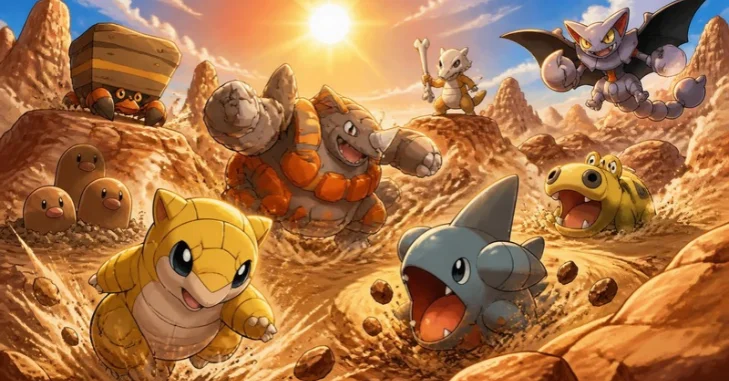
Pure Ground-types take super-effective damage from Water, Grass, and Ice moves. Those three attacking types are your most reliable starting point against them. Dual typing can dramatically change the final matchup, so always check both types.
Water attacks are often easy to fit onto balanced teams. Grass attacks also threaten many Ground and Rock combinations. Ice coverage becomes especially valuable against opponents that combine Ground with Dragon or Flying.
Garchomp shows why secondary typing matters so much. Its Dragon and Ground combination creates a major Ice vulnerability. That matchup differs significantly from a pure Ground Pokémon facing the same attack.
A second type can also remove or soften a normal weakness. Water/Ground combinations create different defensive interactions than pure Ground typing. Never choose a counter using the Ground label alone.
What Are Ground-Type Pokémon Strong Against?
Ground moves deal super-effective damage to Fire, Electric, Poison, Rock, and Steel Pokémon. Few attacking types threaten five different types this directly. That broad coverage explains why Ground attacks remain useful on many teams.
Electric is an especially favorable matchup. A Ground-type Pokémon takes no damage from standard Electric attacks. Its own Ground attacks also hit Electric Pokémon for super-effective damage.
Ground attacks do reduced damage against Grass and Bug. They normally deal no damage to Flying Pokémon. This creates a clear reason to carry secondary coverage moves.
Ground-Type Resistances and Electric Immunity
Pure Ground-types resist Poison and Rock attacks. More importantly, they have a complete immunity to Electric-type attacks. That immunity can create safe switch opportunities when you correctly predict an Electric move.
The immunity is not the same as a resistance. A resisted move still causes reduced damage. An immune target receives no damage from the affected attack.
Dual typing can add several other resistances or weaknesses. Steel/Ground, Dragon/Ground, and Water/Ground combinations all behave differently. Team building should therefore focus on the full typing rather than Ground alone.
Why Ground Attacks Are So Valuable
Ground offers unusually broad offensive coverage. Fire, Electric, Poison, Rock, and Steel all take increased damage from Ground attacks. Several of those types appear frequently across regular battles and competitive formats.
Earthquake is the most recognizable Ground attack. In the main series, it has 100 base power and 100 accuracy under standard conditions. That combination gives physical attackers a dependable high-power option.
Earthquake is not always the correct move, however. Doubles formats create different considerations because Earthquake can affect multiple Pokémon. Other Ground moves may offer better targeting or fit a special attacker.
Flying Pokémon, Levitate, and Other Important Exceptions
Flying-type Pokémon are normally immune to Ground attacks. That means a powerful Earthquake still causes no damage to a standard airborne Flying target. Ground teams therefore need coverage against Flying opponents.
The Levitate ability can create the same immunity for certain non-Flying Pokémon. Effects such as Magnet Rise and Air Balloon can also keep targets above Ground attacks. These mechanics make matchup knowledge more important than type icons alone.
Some effects can remove that protection. Gravity, Smack Down, and several other mechanics can make raised targets vulnerable again. Thousand Arrows also has unusual interaction rules against airborne targets.
Strong Ground-Type Pokémon to Consider
There is no universal best Ground-type for every Pokémon game. Available Pokémon, rulesets, opponents, abilities, and move access all change the answer. A useful choice should fill a specific role on your team.
| Pokémon | Typing | Useful role | Main concern |
|---|---|---|---|
| Garchomp | Dragon/Ground | Fast physical offense | Severe Ice weakness |
| Groudon | Ground | Powerful legendary attacker | Water, Grass, Ice pressure |
| Landorus | Ground/Flying | Flexible offensive or utility role | Ice attacks |
| Excadrill | Ground/Steel | Physical offense and coverage | Several common weaknesses |
| Clodsire | Poison/Ground | Defensive utility | Matchup depends heavily on ability |
| Gastrodon | Water/Ground | Defensive team support | Grass vulnerability |
Garchomp remains an easy example for offensive teams because it combines high pressure with useful typing. Groudon offers a legendary option when the format permits it. Landorus provides another versatile choice across formats where its forms are legal.
Excadrill combines Ground offense with Steel typing. Clodsire can fill a slower defensive role rather than chasing immediate damage. Gastrodon demonstrates how a second type can completely reshape a Ground Pokémon’s matchup profile.
The right choice depends on your game and battle format. Story teams usually value availability and dependable coverage. Competitive teams must also consider legality, abilities, speed tiers, items, and the current ruleset.
How to Build Around a Ground-Type
Start by covering Water, Grass, and Ice threats. A teammate that safely handles those attacks can protect your Ground slot. You should also plan for Flying targets that ignore standard Ground attacks.
Next, avoid relying on Ground damage for every matchup. Add attacks that threaten Flying, Grass, or Bug opponents. Rock and Ice coverage can often help, depending on the Pokémon using it.
Finally, decide what role your Ground choice actually performs. Some are sweepers, while others provide defensive switching or utility. A team becomes stronger when each slot solves a specific problem.
For broader game-related content, readers can browse NewsDean’s Gaming section. Players recording console battles can also use NewsDean’s capture card guide. PC players improving their desk setup can review the site’s mouse pad guide.
Ground Types in Mainline Games vs. Pokémon GO
The basic idea of type advantages also appears in Pokémon GO. However, move strength, availability, battle formats, and rankings work differently there. A strong main-series choice is not automatically the strongest GO investment.
Pokémon GO also changes through balance updates and rotating raid availability. Legendary options may disappear from raids for extended periods. Current GO players should therefore check live movesets and availability before spending resources.
This guide focuses primarily on the conventional main-series type chart. That keeps the weakness and resistance advice consistent. Game-specific rankings should always be checked against the title you are currently playing.
Common Mistakes Players Make With Ground Types
The first mistake is assuming every Ground-type has identical weaknesses. Secondary typing can create double weaknesses, new resistances, or entirely different neutral matchups. Checking both types prevents many avoidable battle losses.
The second mistake is clicking Earthquake into an airborne opponent. Flying typing, Levitate, and temporary airborne effects can block Ground damage. Carrying suitable coverage prevents one immunity from stopping your offense.
The third mistake is choosing a Pokémon only because its Ground attacks hit hard. Speed, defenses, ability, secondary typing, and team support also matter. A slower defensive option can sometimes help more than another physical attacker.
Frequently Asked Questions
What are Ground Pokemon weak to?
They are weak to Water, Grass, and Ice attacks when they have pure Ground typing. A secondary type can change those matchups. Always check both types before choosing your counter.
What types are Ground moves super effective against?
Ground attacks are super effective against Fire, Electric, Poison, Rock, and Steel. They deal reduced damage to Grass and Bug. They normally cannot damage Flying Pokémon.
Are Ground-type Pokémon immune to Electric attacks?
Yes, standard Ground typing provides immunity to Electric-type attacks. That makes Ground Pokémon valuable switch-ins against predictable Electric moves. Secondary mechanics and unusual effects can still affect specific battle situations.
Is Earthquake the strongest Ground move?
Earthquake is one of the most dependable widely available Ground attacks. It combines 100 base power with 100 accuracy in the main series. Other moves can be better for specific Pokémon or battle formats.
Which Ground-type Pokémon should I use?
Choose according to the role your team needs. Garchomp suits offensive roles, while Clodsire can support slower defensive teams. Game version, legality, abilities, and available moves should guide the final choice.
Are Ground and Rock the same type?
No, Ground and Rock are separate Pokémon types with different matchups. Ground resists Rock attacks, while Ground attacks hit Rock for super-effective damage. Many early Pokémon combined both types, which can cause confusion.
Build Around Matchups, Not Just Raw Power
Ground typing earns its value through broad offensive coverage and a complete Electric immunity. Its Water, Grass, and Ice weaknesses remain manageable with thoughtful teammates. Dual typing determines whether a particular Pokémon strengthens or exposes your team.
Before adding one, check your existing weaknesses and coverage options. Then select a Ground-type that fills the missing role. That approach produces a more balanced team than choosing solely by popularity.

